

Physics has been one heck of a mathematical ride, but we are finally coming to a close :).
The Stars are separated from each other by about 32 trillion miles, according to modern scientists. We’ll use this number to find out by how much the atoms in the earth are separated from each other. The proportion is the same, because the earth is a mini-universe.
Let’s look at this again.
The Solar System is 7,900 million miles in size. It’s separated from it’s neighbors by 32 trillion miles. How many Solar Systems would fit in this distance if we could line them up from the sun all the way to the next star?
The answer is:
32 trillion miles / 7,900 million miles = 4,000.
We may call this the proportion of separation.
That means 4,000 star systems will fit in the distance separating two stars. How many atoms will fit in the distance separating two atoms?
4,000.
The same law applies.
As above, so below.
It’s clear that most of the sky consists of empty space. The distance between any two neighboring stars is so large that it can accommodate 4,000 star systems, and yet there are only two stars in that whole distance. The rest is empty space. We may think of each star system as sitting at the center of a huge bubble of empty space 32 trillion miles across. It’s like that with every star system throughout the entire universe, if our intuition is correct that all star systems are separated from each other by about the same distance.
The same is true then for the earth and its atoms. Most of the volume of the earth is empty space, because 4,000 atoms can fit in the space between any two atoms.
Now we must let our minds be free to think clearly. When we say that most of the volume of the earth is empty space, someone might ask, “Why don’t we fall through this empty space?”
We can fall through the empty space between stars, but not that between atoms. These are microscopic spaces. The atoms themselves are even more microscopic, being 4,000 times smaller. That’s what we mean when we say the earth is mostly empty space. The atoms are so tiny compared to the space between them that they occupy very little of the earth’s total volume.
So yes, the earth is made of mostly empty space just like the sky, but no, we cannot fall through.
If the stars are separated by 32 trillion miles, by how much are the atoms separated?
The proportion of separation is the same; it’s 4,000.
The size of the atom is 1/4 millionth of an inch across. Multiplying this by the proportion of separation, we get:
1/4 millionth inch x 4,000 = 1 thousandth of an inch.
Therefore any two atoms are separated by 1 thousandth of an inch, just like any two stars are separated by 32 trillion miles. Now we are closer to finding out the size of the universe. We just have to find out how many atoms make up the earth, and that will tell us how many stars make up the universe.
The law of creation has made an earth whose size we can handle and use to understand the universe, whose size we cannot handle so easily.

ACTUALLY BLACKROOTS, WE ARE 1 LIGHT YEARS AWAY FROM THE CLOSEST STAR OF ALPHA CENTAURI. IT IS A FAIRLY EASY CALCULATION. I REMEMBER IT FROM HIGHSCHOOL.
1 LIGHT YEAR = 60 SECONDS \ 60 MINUTES \ 24 HOURS \ 365.25 DAYS (NOT SIDEREAL) \ 186,000 MILES/SECOND = 5.8697136 X 10^12 MILES
THUS THE EARTH STAR (SOL) IS 5.86 TRILLION MILES FROM ALPHA CENTAURI.
According to the “Amateur Astronomer’s Handbook”, on pg 253:
“...the nearest star to our sun is 4.33 light years away.”
More recently, in the “Oxford Astronomer’s Encyclopedia”, p10:
“Alpha Centauri, the closest naked-eye star to the sun, is 4.4 light years away”. That’s 25.8 trillion miles.
Also, p323, “Proxima Centauri is the closest star to the sun, at 4.22 light years away” (This is not a naked-eye star, but can be seen by telescope).
These are only 2 stars. Another is the star Altair, located at 16.8 light years away, or the well known star Sirius, at 8.6 light years away, or 49 tril miles. The earth (or our solar system) is surrounded by many thousands more that are a bit farther away. They all form a canopy, or bubble, so to speak, that completely surrounds our solar system. The ceiling of this bubble may indeed be approximated at 32 trillion miles.

The Size of the Earth and the Universe
How many atoms make up the earth? We can calculate the volume of the atom, since we know its size, and then calculate the volume of the earth, and divide the second by the first to find the number of atoms. But that would be incorrect because it would ignore most of the insides of the earth, which is mostly empty space, as we already saw. A correct way is to calculate the volume of this empty space, and ignore the volume of the atom, which is much smaller. Remember, the empty space between atoms is 4,000 times larger than the atom itself.
Some people who are more mathematically inclined might suggest that we take both the volume of the atom and the empty space and add them together and use that number in our calculation. That would be right, the answer would be absolutely correct. But consider this: The atom is 4,000 times smaller than the space between atoms. If we ignore its size to simplify the calculation, it is exactly like someone saying, “I have $40 in my pocket”, when in fact he has $40 and one penny. Ignoring the penny simplifies matters. A penny is 4,000 times less than $40, and can be ignored without affecting the final answer.

Similarly, the atom is 4,000 times smaller than the separating space, and its size may be ignored for the sake of simplicity without affecting the final answer.
I mention this now in such great detail because we will face this situation time and again when we begin to deal with larger numbers. Although it is possible to make 100% correct calculations, most of the time it’s better to make a calculation that is 99% accurate for the sake of simplicity and understanding. Once understanding is reached, anyone can then go back and improve the accuracy of the calculation.
So much for that.
The empty space between atoms, as already said, has a size of 1 thousandth of an inch, which we change to miles, and get 16 billionths of a mile. It makes a volume of:
16 billionths x 16 billionths x 16 billionths = 4 trillionths trillionths.
The earth is 7,900 miles across. It makes a volume of:
7,900 x 7,900 x 7,900 = 1/2 trillion.
Dividing the second volume by the first will give us the number of atoms inside the earth.
1/2 trillion / 4 trillionths trillionths = 125 billion trillion trillion.
A very large number, to say the least.
Therefore there are 125 billion trillion trillion atoms inside the earth.
Now, someone might be wondering about this matter of dividing volumes and not understanding how it gives us the number of atoms.
Let us step aside for a moment and think of a common everyday example.

A drop of water dripping out of a faucet is about 1/4 inch across. There’s a cup shaped like a ball underneath the faucet, catching the water, or maybe there’s a tennis ball there instead, with a small hole in it. A tennis ball is about 4 inches across (maybe smaller). The water drips until it fills the tennis ball. If you come in right at the end of this little experiment of ours, and you see the last drop falling in, and I ask you, “How many drops did it take to fill the ball?”, how will you calculate it?
You have to use volumes because the water, once the ball is filled, will have the same volume as the tennis ball. If you divide this volume by the volume of one droplet, that will tell you how many drops it took to fill the container. So here goes:
A drop of water is 1/4 inch across. It makes a volume of:
1/4 x 1/4 x 1/4 = 0.015625
A tennis ball is 4 inches across. It makes a volume of:
4 x 4 x 4 = 64
64 / 0.015625 = 4,096
Therefore there are 4,096 drops of water inside the tennis ball.
Now, imagine the drop of water coming out of a tiny syringe needle. Let’s say this droplet is only 1 thousandth of an inch across (of course, in reality the droplet is bigger, but you know where I’m going with this).
These droplets coming out of the needle are dripping into a ball as before. A much bigger ball.
In fact (surprise, surprise), the ball is exactly 7,900 miles across, the same size as the earth!
How many droplets will it take to fill the earth-ball? Here goes again: The droplet is 1 thousandth of an inch across, which is 16 billionths of a mile. It makes a volume of:
16 billionths x 16 billionths x 16 billionths = 4 trillionths trillionths.
The earth-ball is 7,900 miles across. It makes a volume of:
7,900 x 7,900 x 7,900 = 1/2 trillion.
1/2 trillion / 4 trillionths trillionths = 125 billion trillion trillion.
That’s how many droplets are inside the earth-ball. The tiny droplet represents the bubble of empty space surrounding a single atom. At the center of this bubble or droplet is the atom itself, 4,000 times smaller than the droplet in size.
How many atoms are inside the earth-ball?
Same number as droplets, because there’s one atom at the center of each.
Hence we conclude again that the total number of atoms inside the earth is 125 billion trillion trillion.
How many stars are in the universe?
SORRY MAN, THE EARTH IS NOT AN EMPTY HOLLOW BALL LIKE YOU’RE SAYING. IT IS A BIG ROCK WITH WATER ON TOP. YOUR THOUGHTS ARE NICE, BUT THOSE THOUGHTS ARE NOT SCIENCE.
To understand how atoms make up our earth, it’s convenient to assume that at the beginning, the earth was a hollow ball. This ball is then filled with atoms. It is these same atoms that form the “rock and water on top”, as you put it, as well as the atmosphere. If we take into account the magnetic separation that naturally separates the atoms, as well as the size of the earth, the number of these atoms can be approximated at 125 billion trillion trillion, as shown in the calculations in BRS5.
ARE YOU TAKING THE AVERAGE SIZE OF AN ATOM?
AS YOU KNOW DEPENDING ON THE ATOMIC NUMBER THE AMOUNT OF PROTONS, THEREFORE ELECTRONS, INCREASES. HYDROGEN HAS ONE ELECTRON ORBITING THE NUCLEUS. IN THE CASE OF IRON(FE) THERE ARE 26 ELECTRONS ORBITING THE NUCLEUS. IN THEORY, THE FIRST SHELL-ORBIT CAN ONLY SUPPORT 2 ELECTRONS. THE NEXT SHELL CAN SUPPORT 8. THEREFORE, DEPENDING ON THE ATOM, YOU WILL HAVE SPACE BETWEEN THE FIRST SHELL AND THE NUCLEUS AND THEN SPACE BETWEEN THE 1ST SHELL AND THE 2ND THEN THE 2ND AND 3RD AND SO ON. SO DEPENDING ON THE ATOMIC NUMBER THE “SIZE” OF AN ATOM CAN CHANGE.
ALSO THE VOLUME OF THE EARTH WOULD BE CONSIDERED SPHERICAL NOT CUBED AND THEREFORE GOVERNED BY THE EQUATION:
PI*((R)SQUARE) INSTEAD OF ((S)CUBE) OR L*W*H R BEING HALF THE NUMBER YOU MENTIONED.
THE VOLUME OF THE ATOM IS TRICKY BUT WOULD PROBABLY MEASURE MORE ACCURATELY IF YOU USED THE VOLUME OF A SPHERE. FROM WHAT I REMEMBER THE ELECTRON ORBITS ARE VERY IRREGULAR. I THINK THE FORCES AND MOVEMENTS OF SUB-ATOMIC PARTICLES NOW FALL UNDER THE THEORY OF QUANTUM MECHANICS.
WHOOPS! MY BAD. I GAVE THE AREA OF A CIRCLE.
THE VOLUME OF A SPHERE IS: 4/3*PI*((R)CUBE)
Yes, I’m using an average estimate for the atom size. The Carbon atom is given as 6 billionths of an inch, and Carbon has only 6 electrons. It’s one of the smaller ones. The size of the electron is very small compared to the gap separating electron orbital circuits, or shells. As you rightly say, the atom sizes will vary greatly. A hundred-electron atom, Fm (Fermium), will be much bigger than either Carbon or Hydrogen. So the sizes will range from less than 1 billionth of an inch to over a thousandth of an inch due to these orbital gaps. The proportion of these gaps is analogous to the distance between planets in our solar system. The earth is only 7,900 miles across; compare that with the gap between earth and mars, which is about 60 million miles. This same proportion separates the electron orbital shells. So you are right about the increasing size of atoms. I took a median, or midway point between a billionth (for the smaller atoms) and a thousandth of an inch (for the larger ones), and came up with about a millionth of an inch.
On the second question of the volume of the earth and the atom, I did use the spherical volume formula, which you are right, is 4/3 pi R cubed. But R, or radius, can be written in terms of diameter. Clearly, as you know, diameter is twice radius, or R = 1/2 D. So the formula can be written as:
4/3 pi (D/2)cubed or 1/6 pi D cubed.
The factor 1/6 pi is common to all spheres, large and small. When dividing the volume of one sphere (earth) by that of another (atom), the common factor cancels out. So I ignored it from the start. The effect is the same as using cubic volumes. I’m sure you’ll agree that ignoring common factors from the start greatly simplifies the calculation.
As to the irregularities of electron orbits, and their designation to the realm of quantum mechanics, there you raise a very involved issue, but not at all complicated. It is made complicated by those who do not know (or even ignore) the true origin of things. (I think you know the race I’m referring to). I will address this topic in a later BRS.
YOU’VE MENTIONED ELECTRONS, BUT WHY NOT PROTONS AND NEUTRONS?
DO PROTONS REPRESENT POSITIVE ENERGY AND ELECTRONS NEGATIVE ENERGY?
DO YOU AGREE THAT THEIR ARE 12 PLANETS IN OUR SOLAR SYSTEM, LIKE THE SUMERIAN TABLETS ILLUSTRATE?
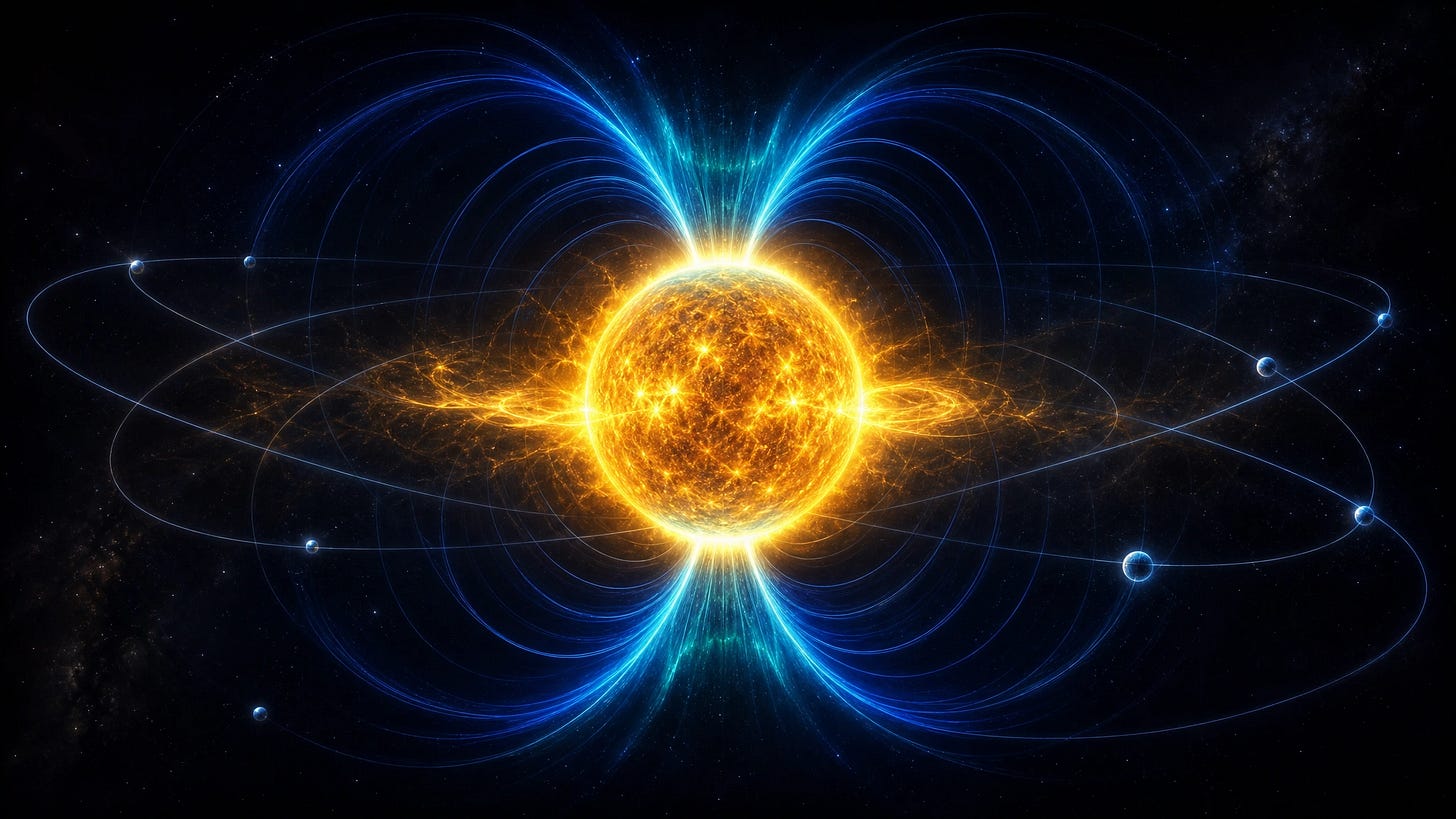
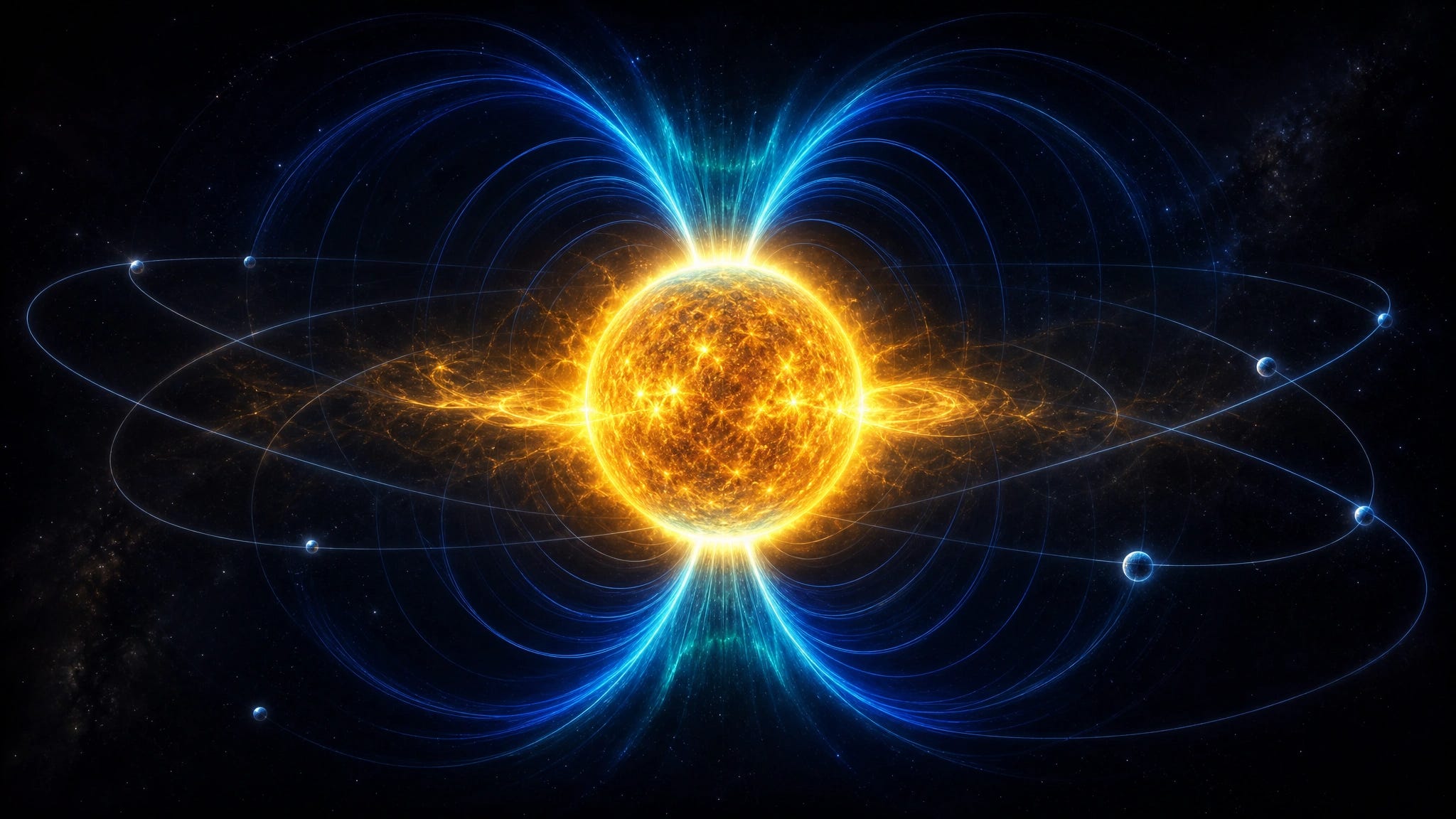
What are called protons and neutrons refer to the makeup of the nucleus. The nucleus of an atom is a sun, literally. The sun is primarily a magnetic, electrical and light body. As with all large bodies in space, it has magnetic poles, a negative and positive pole, or north and south, just like the earth. The polarities of these poles give rise to what are called protons. So a proton is not a particle, or separate body like an electron (which is literally a planet), but simply an effect of the magnetic poles of the sun (nucleus).
The substances that make up the sun are under the influence of its magnetic field. This influence/interaction gives rise to another effect that scientists call the neutron. Both the proton and the neutron are the effects of the sun’s magnetic field. When they are studied on an electronic scale, these effects give the illusion of actual moving particles, and so modern scientists call them protons and neutrons.
On the question of the number of planets:
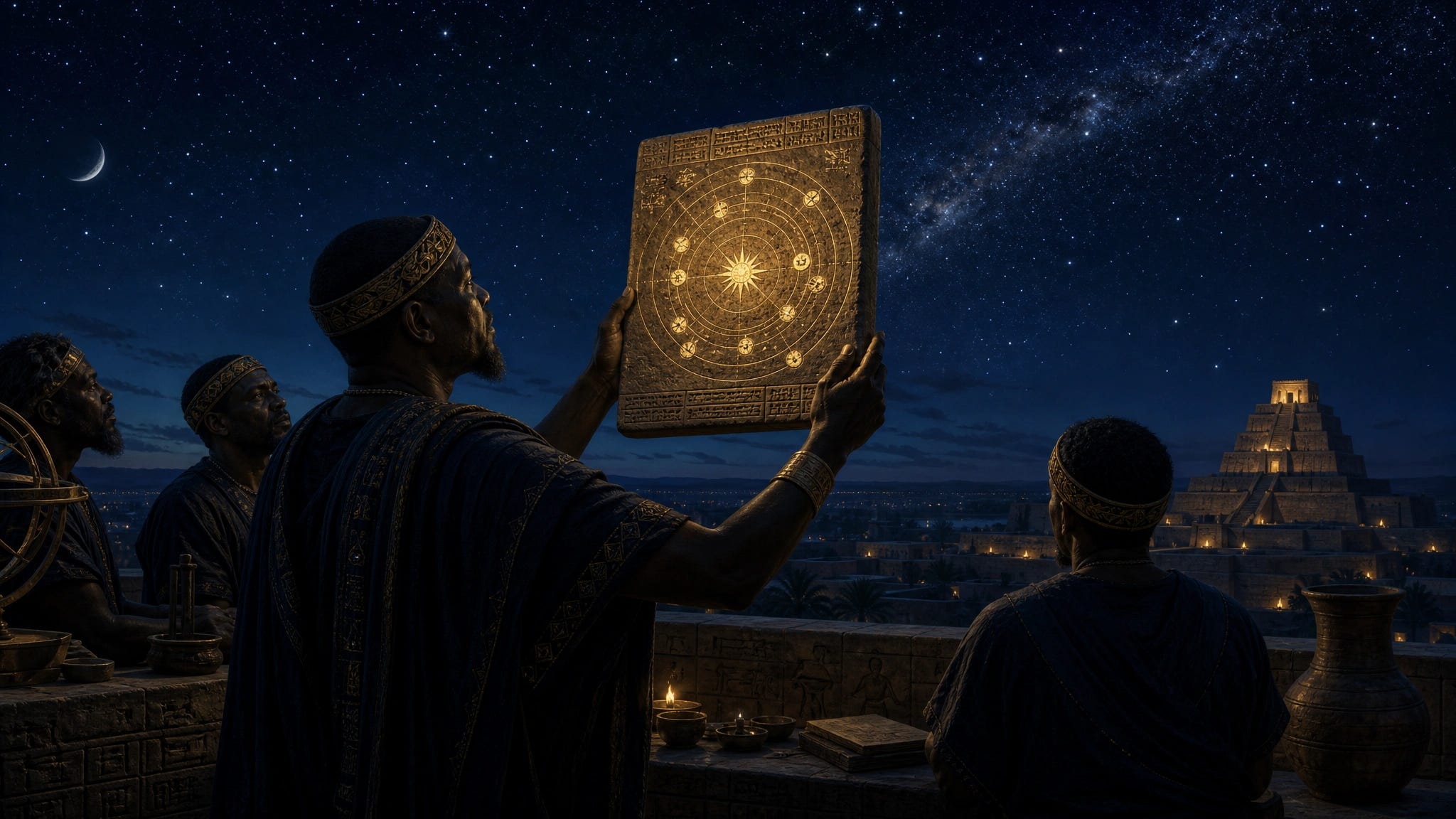
There are many smaller spheres slightly smaller than Pluto beyond the boundary of our solar system. They cannot be called planets. Occasionally, as the thousands of years pass, some of them enter our solar system and establish temporary orbits long enough to be regarded as planets. They were recorded as such by some ancient astronomers, especially the astronomers of Sumer.
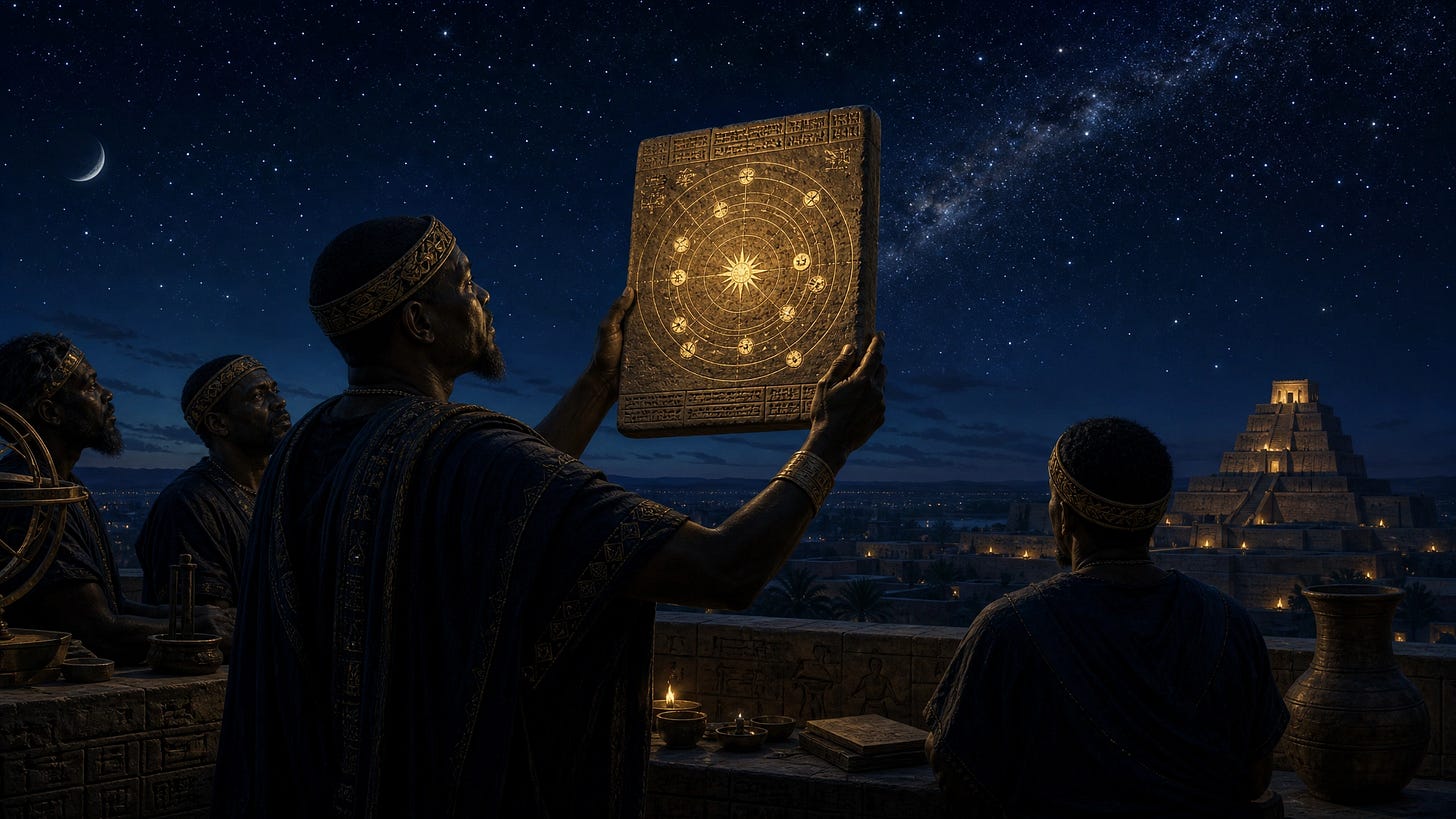
The Sumerian Astronomers. After some millennia in these orbits, they are always captured by the larger planets like Jupiter and Saturn to become their moons.
SO HOW CAN YOU AGE THE EARTH (THE UNIVERSE) BY CALCULATION? HOW OLD IS IT AND HOW MUCH TIME IS IT LEFT FOR ITS COMPLETION?
The estimated total number of star systems in the universe is 125 billion trillion trillion, as I described in one of the posts on astronomy/physics. The Gods send 144000 settlers from the first earth every 7000 years to inhabit these star systems, most of which have earth-like planets. This is how our earth was first inhabited 78 trillion years ago by 144,000 of our ancestors who came from another star system. When the entire universe is inhabited by Black people, then the universe will have attained its purpose, and will come to an end and be replaced by a new one. This has been going on without beginning, and will never end. The full age of the universe at that time will be about 875 trillion trillion trillion years.


The Creation of the Universe
There are 125 billion trillion trillion atoms in the earth. How many stars are there in the universe?
125 billion trillion trillion.
Same number as atoms in the earth.
As below, so above.
The earth is a model of the universe that God presents to us to enable us to comprehend the universe and its stars. For the earth, the atoms are its stars.
How big is the universe?
We can find the answer by asking, how big is the earth? And what is its proportion of size in relation to the atom? In other words, how much bigger than the atom is the earth?
The atom is 1/4 millionth of an inch across, which in miles is 4 trillionths. The earth is 7,900 miles across.
The proportion of size is 7,900 / 4 trillionths = 2,000 trillion.
That means the earth is 2,000 trillion times bigger than the atom.
What this tells us, according to the law, is that the universe is 2,000 trillion times bigger than the solar system.
So its size is 2,000 trillion x 7,900 million = 16 trillion trillion.
The universe is 16 trillion trillion miles across and has 125 billion trillion trillion stars.
The earth is 7,900 miles across and has 125 billion trillion trillion atoms.